Sunday, 24 February 2013

M.C. Escher
Maurits Cornelis Escher (17 June 1898 – 27 March 1972), usually referred to as M. C. Escher, was a Dutch graphic artist. He is known for his often mathematically inspired woodcuts, lithographs, and mezzotints. These feature impossible constructions, explorations of infinity, architecture, and tessellations.
His artistic expression was created from images in his mind, rather than directly from observations and travels to other countries. Well known examples of his work also include Drawing Hands, a work in which two hands are shown, each drawing the other.

The reason I chose Escher as one of the artists is because his work doesn't focus on the drawing itself, but the way your mind responds to them. He specialises with illusions and impossible structures which are all about confusing the viewer into trying to figure out how that illusion works.
My first impression of this artist was that he was a genius in creating patterns. His first works I saw were the drawings of shapes that would fit between one another leaving no gaps between. I looked deeper into this artist to seek meaning behind his work and found inspiration for this project.
The artist uses pencil to create tonal drawings of impossible structures. The main formal elements are tone, shape and pattern which the artist uses o create depth in his drawings and makes parts of it stand out giving them a 3D effect. This technique helps him create the illusions such as the "Waterfall" from 1961 where the artist creates an effect where the top of a bridge connects to the buttom of the building in a straight zig zag line.
Eschers work links to my research about illusions. This artist didn't use lights in order to create such illusions; however I'm only looking at how he caused the images to trigger your brain into thinking of how to make sense out of an impossible structure. As a responce, I want to explore if I can achieve a similar effect using lights such as glow sticks.
 (Waterfall - 1961
His artistic expression was created from images in his mind, rather than directly from observations and travels to other countries. Well known examples of his work also include Drawing Hands, a work in which two hands are shown, each drawing the other.

The reason I chose Escher as one of the artists is because his work doesn't focus on the drawing itself, but the way your mind responds to them. He specialises with illusions and impossible structures which are all about confusing the viewer into trying to figure out how that illusion works.
My first impression of this artist was that he was a genius in creating patterns. His first works I saw were the drawings of shapes that would fit between one another leaving no gaps between. I looked deeper into this artist to seek meaning behind his work and found inspiration for this project.
The artist uses pencil to create tonal drawings of impossible structures. The main formal elements are tone, shape and pattern which the artist uses o create depth in his drawings and makes parts of it stand out giving them a 3D effect. This technique helps him create the illusions such as the "Waterfall" from 1961 where the artist creates an effect where the top of a bridge connects to the buttom of the building in a straight zig zag line.
Eschers work links to my research about illusions. This artist didn't use lights in order to create such illusions; however I'm only looking at how he caused the images to trigger your brain into thinking of how to make sense out of an impossible structure. As a responce, I want to explore if I can achieve a similar effect using lights such as glow sticks.
(Waterfall - 1961Dan Flavin
Dan Flavin (April 1, 1933, Jamaica, New York – November 29, 1996, Riverhead, New York) was an American minimalist artist famous for creating sculptural objects and installations from commercially available fluorescent light fixtures.
 Dan Flavin's large-scale work in colored fluorescent light for six buildings at the Chinati Foundation was initiated in the early 1980s, although the final plans were not completed until 1996. The work was inaugurated at the museum's annual Open House in October 2000.
Flavin was an artist who loved to work with film and different hue saturation's within them. He also loved the huge variations in color and he used light to explore this variation. His work would sometimes consist if the same object repeated, but lit up by a different light. The color of the light greatly changed the way you look at the artwork and gives a completely new feeling than it would of if it was just a single color.
I found the idea of using different color light very interesting and decided to do a few experiments of my own. I took my response to Nicholas Wright and rendered different filters through the light to change the color of the response. I had a cyan, purple as well as a red filter and came up with 3 different responses which all come from the same original piece. The only difference in them is the color of the light and as you look into them one by one, each contains it's own atmosphere and links back to my original idea of light creating an illusion.


 Dan Flavin's large-scale work in colored fluorescent light for six buildings at the Chinati Foundation was initiated in the early 1980s, although the final plans were not completed until 1996. The work was inaugurated at the museum's annual Open House in October 2000.
Two parallel tilted corridors are constructed at the connecting arms of each U-shaped building. These corridors contain light barriers that are placed either in the center or at the end of each corridor. The barriers consist of eight-foot-long fluorescent light fixtures, occupying the entire height and width of the corridor. The tubes are installed with space between them, allowing a view through the barrier. Each fixture holds two differently colored bulbs shining in opposite directions. The barriers in the six buildings utilize four colors: pink, green, yellow, and blue. The first two buildings use pink and green, the next two yellow and blue, and the last two buildings bring all four colors together. Two windows at the end of each long arm of the U allow daylight to enter the building and permit a view into the vast landscape.
Flavin was an artist who loved to work with film and different hue saturation's within them. He also loved the huge variations in color and he used light to explore this variation. His work would sometimes consist if the same object repeated, but lit up by a different light. The color of the light greatly changed the way you look at the artwork and gives a completely new feeling than it would of if it was just a single color.
I found the idea of using different color light very interesting and decided to do a few experiments of my own. I took my response to Nicholas Wright and rendered different filters through the light to change the color of the response. I had a cyan, purple as well as a red filter and came up with 3 different responses which all come from the same original piece. The only difference in them is the color of the light and as you look into them one by one, each contains it's own atmosphere and links back to my original idea of light creating an illusion.
Cyan Filter

Purple Filter

Red Filter

I decided to use another piece of media as a response which is video. Dan Flavin often used film in his artwork and demonstrated how different filters of light changed the mood of a room. Carrying from what I had above, I created a small light box. I used one of my photographs of an arcade and used the different color filters to fill the room with various colors. I also made an affect of the light turning on and off rapidly and switching the filters while doing so. I used red, blue and green pieces of fabrics and plastics and placed them at the top and then was able to get light through with various effects.
,
Here is the set in different colors:


Bruce Nauman
Bruce Nauman
The thing this artist does that made me take an interest in him, is how work with neon lights. My project focuses around lights and how indoor and outdoor lights effect the space as well as people within that space as well as the experience they gain from it. Nauman creates great installation with light that clearly link with what I want to achieve in this project.
Nancy Spector wrote:
"Bruce Nauman defies the traditional notion that an artist should have one signature style and a visually unified oeuvre. Since the mid-1960s the artist has created an open-ended body of work that includes fiberglass sculptures, abstract body casts, performances, films, neon wall reliefs, interactive environments, videos, and motorized carousels displaying cast-aluminum animal carcasses. If anything links such diverse endeavors, it is Nauman’s insistence that aesthetic experience supersedes the actual object in importance. Perception itself—the viewer’s encounter with his or her body and mind in relation to the art object—can be interpreted as the subject matter of Nauman’s work. Using puns, claustrophobic passageways with surveillance cameras, and videotaped recitations of bad jokes, he has created situations that are physically or intellectually disorienting, forcing viewers to confront their own experiential thresholds."
The artist uses light to make viewers want to interact with the surroundings just as you would in a normal public environment. The artist is using light to recreate this experience and keeping that experience within an artwork.

Green Light Corridor, 1970. Painted wallboard and fluorescent light fixtures with green lamps
My first impressions of his artwork were mixed. As I looked at his neon installations, I could never capture everything with one glance and within one photo. I had to look at several before I could get around the whole artwork. The image above is an example of that. If you walked into the room through that yellow door, you would not be able to see the artwork. You would have to walk around it to see it fully.
Forcing people into moving around the artwork is also the artist's intent. He wanted to create something that you cannot experience from a single photo or from standing still when looking at it in real life.
His artwork creates a feel of curiosity. Usually when you look at something, you glance at it and move on whereas here, you cannot leave the artwork alone without having to move around it.
The thing I like about this artwork the most is that it's interactive, but at the same time you can't do anything to it. You interact by simply walking in circles around the artwork and looking at it from different sides. You also gain different experiences depending on which side you are looking from. If you looked at it from an entrance, you will see a wall with light behind it, but as you move closer, you realise there is another wall behind and the light is actually in the middle.
I think this artist links to my theme of light and illusion. The artist's work is all about deceiving people and forcing them to move around the neon installation which gives them various experiences. My research in Piccadilly Circus gave me similar experiences on it's own. The Trocadero section is filled with neon lights and the place itself feels like one huge installation in style of Bruce Nauman. As you walk around it, you never get enough experience and it makes you want to stay there for longer in order to get around every part of that place.
Links to other artists:
Bruce Nauman is an artist who works in a similar way to Dan Flavin. Although their intentions are different, they use a variety of similar materials and techniques in their work, The main one being working with neon Lights.
In my light box response, I used a variety of color filters to create different atmospheres. Both Flavin and Nauman used various color neon lights throughout their works and both would use an area or a room which in my case was the small box.
,
Responses
Something very interesting I found when experimenting with light and perspectives was the angle that the picture is taken at. Below you can see 2 images which look completely different; however they are the same thing simply taken from another angle. I just moved the camera around 15 degrees and the whole light in the image changed drastically.
It wasn't an exact response where I used my primary sources, but it was something I really found interesting and I think this links into Bruce Nauman because his work was all about different perspectives and allowing people to experience the same thing differently when moving around it. This was clearly demonstrated in this experiment because the atmosphere in the image changes drastically when you look at it from different angles and perspectives.


Thursday, 21 February 2013
Primary and Secondary Sources
Picadilly Circus images:


Balham Images:


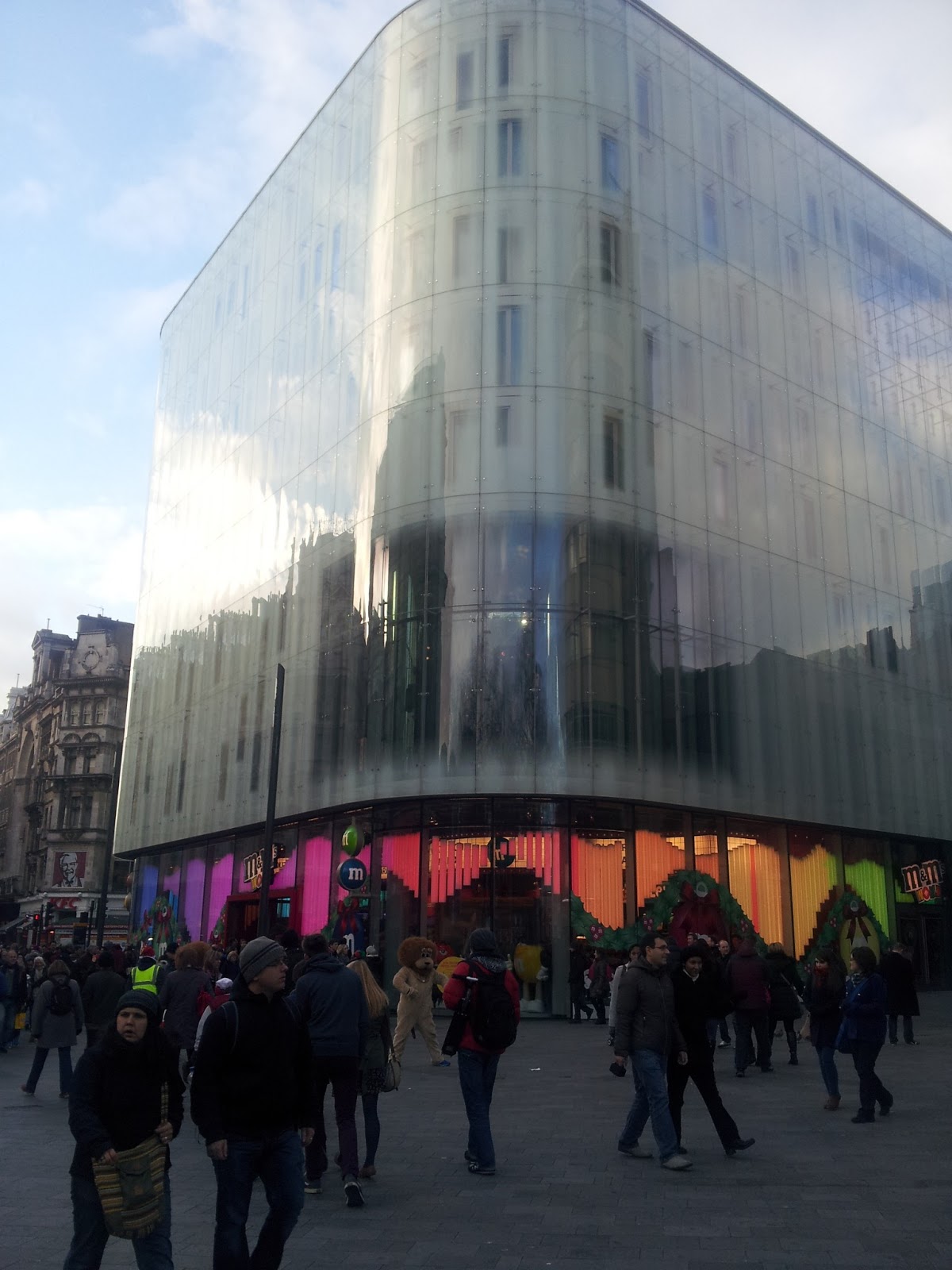


Balham Images:


Balham Video
Leaflets and collected items


Brief and Proposal
Title: Light and illusion
Candidate Number: 6034
Candidate name: Adam Borowski
Theme: Light and Illusion
Aims of the project:
In this project, I want to explore and show different perspectives our eyes receive from lights within closed and outdoor areas. My research starts off in Picadilly Circus in the area of Trocadero. Trocadero is a place inside the building that is filled with shops and arcades and the main thing that makes this place so incredible is light. I visited this place several times and got many ideas in how I could go off and in-cooperate light into further research as well as a possible final outcome.
The aim of this project is to show how something stationary (in my situation light) can create a feel of movement in our heads without having to actually move. It will be dilemmas such as walking out of a tube station and waiting for our eyes to adjust, or feeling dizzy from constant contact with light.
The client I want to create a final outcome for is Chestnut Grove. I want to create an installation that will be photographed and later used to create a series of photoshop pannels showing off the illusions of light fromPiccadilly Circus and Balham.
Primary sources and secondary sources:
My primary sources will be collected using mainly photography; however I will collect items while photographing such as electronics, items that create reflections or give out light. As well as that, I will have drawings, paintings and sketches that show the contrast of lights within a space. My secondary sources will be images from the Internet and books about light as well as information on how light can affect us and how it was shown in various installations.
Ideas and responses:
I will gather photographs in Picadilly Circus and Balham and start to respond to them using chalk showing contrast in tones as well as how the light creates the atmosphere of an area. This will respond to the artists Dan Flavin and Bruce Nauman who both look at how a light effects people and space.
Critical and contextual References and influences:
My biggest influences are the artists Dan Flaving, Bruce Nauman as well as James Whistler who focus around light at different times of the day. They will link to my light reasearch from London and I will develop responces from the reaearch by using influences from the artists.
Intended techniques, media, processes and timescales:
The main tool of recording in this project will be photographs. The responses will be created using a variety of media such as chalk, pencils, glow sticks, CAD, paints, Collage and Sculpture
Some of my weaknesses are:
- Painting
Intended final outcome/s:
I want my outcome to be an installation that will make people want to experience it's content from different sides and angles. I will know that the installation was a success if people are confused by the sculpture and want to try and figure things out by moving around the installation. To achieve this result, I want to use light as the main source as well as filters such as transparent color paper which will cause the light to turn to different colors. Perhaps turning it into a 3D installation while still maintaining the idea of using multiple materials to achieve different effects while using lights.
Candidate Number: 6034
Candidate name: Adam Borowski
Theme: Light and Illusion
Aims of the project:
In this project, I want to explore and show different perspectives our eyes receive from lights within closed and outdoor areas. My research starts off in Picadilly Circus in the area of Trocadero. Trocadero is a place inside the building that is filled with shops and arcades and the main thing that makes this place so incredible is light. I visited this place several times and got many ideas in how I could go off and in-cooperate light into further research as well as a possible final outcome.
The aim of this project is to show how something stationary (in my situation light) can create a feel of movement in our heads without having to actually move. It will be dilemmas such as walking out of a tube station and waiting for our eyes to adjust, or feeling dizzy from constant contact with light.
The client I want to create a final outcome for is Chestnut Grove. I want to create an installation that will be photographed and later used to create a series of photoshop pannels showing off the illusions of light fromPiccadilly Circus and Balham.
Primary sources and secondary sources:
My primary sources will be collected using mainly photography; however I will collect items while photographing such as electronics, items that create reflections or give out light. As well as that, I will have drawings, paintings and sketches that show the contrast of lights within a space. My secondary sources will be images from the Internet and books about light as well as information on how light can affect us and how it was shown in various installations.
Ideas and responses:
I will gather photographs in Picadilly Circus and Balham and start to respond to them using chalk showing contrast in tones as well as how the light creates the atmosphere of an area. This will respond to the artists Dan Flavin and Bruce Nauman who both look at how a light effects people and space.
Critical and contextual References and influences:
My biggest influences are the artists Dan Flaving, Bruce Nauman as well as James Whistler who focus around light at different times of the day. They will link to my light reasearch from London and I will develop responces from the reaearch by using influences from the artists.
Intended techniques, media, processes and timescales:
The main tool of recording in this project will be photographs. The responses will be created using a variety of media such as chalk, pencils, glow sticks, CAD, paints, Collage and Sculpture
- Painting
Intended final outcome/s:
I want my outcome to be an installation that will make people want to experience it's content from different sides and angles. I will know that the installation was a success if people are confused by the sculpture and want to try and figure things out by moving around the installation. To achieve this result, I want to use light as the main source as well as filters such as transparent color paper which will cause the light to turn to different colors. Perhaps turning it into a 3D installation while still maintaining the idea of using multiple materials to achieve different effects while using lights.
Subscribe to:
Posts (Atom)